
Not using the programme did not mean a merchant was not recommending SumUp.
Product design case study · SumUp · Referral programme
Product growth:
Referral programme
Understanding why merchants recommend SumUp, and making the referral programme easier to discover.
Project timelineDiscovery · 2 months
Delivery and iteration · 3 months
Delivery and iteration · 3 months
At a glanceAudience scale
& project impact
& project impact
31countries where SumUp operates
+1.5mactive small business users
+20%increase in link shares after implementation
93%average programme evaluation from 1,700+ answers
01

Situation
A programme with gaps in understanding and visibility.
SumUp’s Refer a Friend programme rewarded people for introducing new merchants. But we lacked a clear picture of how recommendations became formal referrals, how well people understood the programme, and how satisfied they were with the experience.
Merchants could recommend SumUp without using the programme, leaving those recommendations outside the tracked referral journey. People did not always understand how it worked or what happened after a referral, while the team lacked visibility into their experience and programme satisfaction.
Before deciding what to improve, we needed to understand these gaps: what motivated people to refer, what prevented them from using the programme, and where clearer information or better visibility could help.
I worked across research, product design and strategy, with a product manager, data analyst and mobile developer, supported by Marketing.
Design challenge
How might we make referrals easier to understand and complete, while giving the team a clearer view of referral behaviour and programme satisfaction?
02
Research & approach
Understand what motivates referrals — and what gets in the way.
Research goal: What motivates people to refer SumUp, and which factors engage or discourage them throughout the referral journey?
Starting hypotheses
Analysing referral data and acquisition history surfaced questions, certainties, doubts and assumptions to test:
- A 5% discount may not be motivating enough.
- People may disengage when they cannot see or get feedback on the full journey.
- Merchants may share more if rewards are paid faster.
- The existing sharing format may not be attractive enough.
We mapped our certainties, doubts and assumptions, then used internal data to refine our questions and recruit participants. I explored motivations, experiences and satisfaction through merchant interviews and usability testing. We also ran a dedicated survey for the Refer a Friend programme, expanding beyond the company-wide survey that had been available previously. It received more than 1,700 answers and recorded a 93% average evaluation. I then ran user testing in Maze, with more than 400 validation responses.
I brought the findings together to inform audience profiles and the following quarter’s product strategy. Follow-up questions also explored how merchants heard about referral promotions and kept up with SumUp.
Research process
Data analysisSales and Customer Support inputs
Company contextCross-functional data and analytics
Journey mappingWith Marketing and Sales
Research validationModerated and unmoderated studies
Specific moments in the merchant journey made people more likely to refer.
The friend’s discount was not clearly understood or consistently mentioned.
Only 2 of 18 interviewees mentioned following up on their referral reward.
Participants found the value proposition confusing, and the friend’s discount was not consistently mentioned.
A free discount was the clearest response when asked what would encourage more referrals.
Validation examples
“I refer because it is good.”
“I refer because I use it.”
We also explored what happened after someone shared a referral link, whether merchants knew about referral promotions, and how they kept up to date with SumUp.
03
Design direction
Create another way into the programme.
Research pointed us towards a new touchpoint as a quick win: another opportunity for merchants to discover Refer a Friend within their experience of SumUp.
The findings gave us two criteria for that direction: reach merchants when referral felt relevant, and make the benefit easier to understand. The opportunity was to connect an existing behaviour with the programme.
Research insight
→Merchants could recommend SumUp without using the referral programme.
Product response
Create a new entry point, informed by referral motivations and moments in the merchant journey.
Interview findings also showed that few participants actively followed up on their reward. Together with confusion around the friend’s discount, this suggested that visibility alone would not explain the whole experience: merchants also needed a clearer understanding of the benefit.
This case study focuses on the new entry point within a broader research-led roadmap.
Interface evolution
From a single referral flow to a clearer, more flexible experience.
The earlier flow concentrated the programme in a small number of screens. The updated direction brought referral actions, challenges and reward visibility into a clearer entry point.
From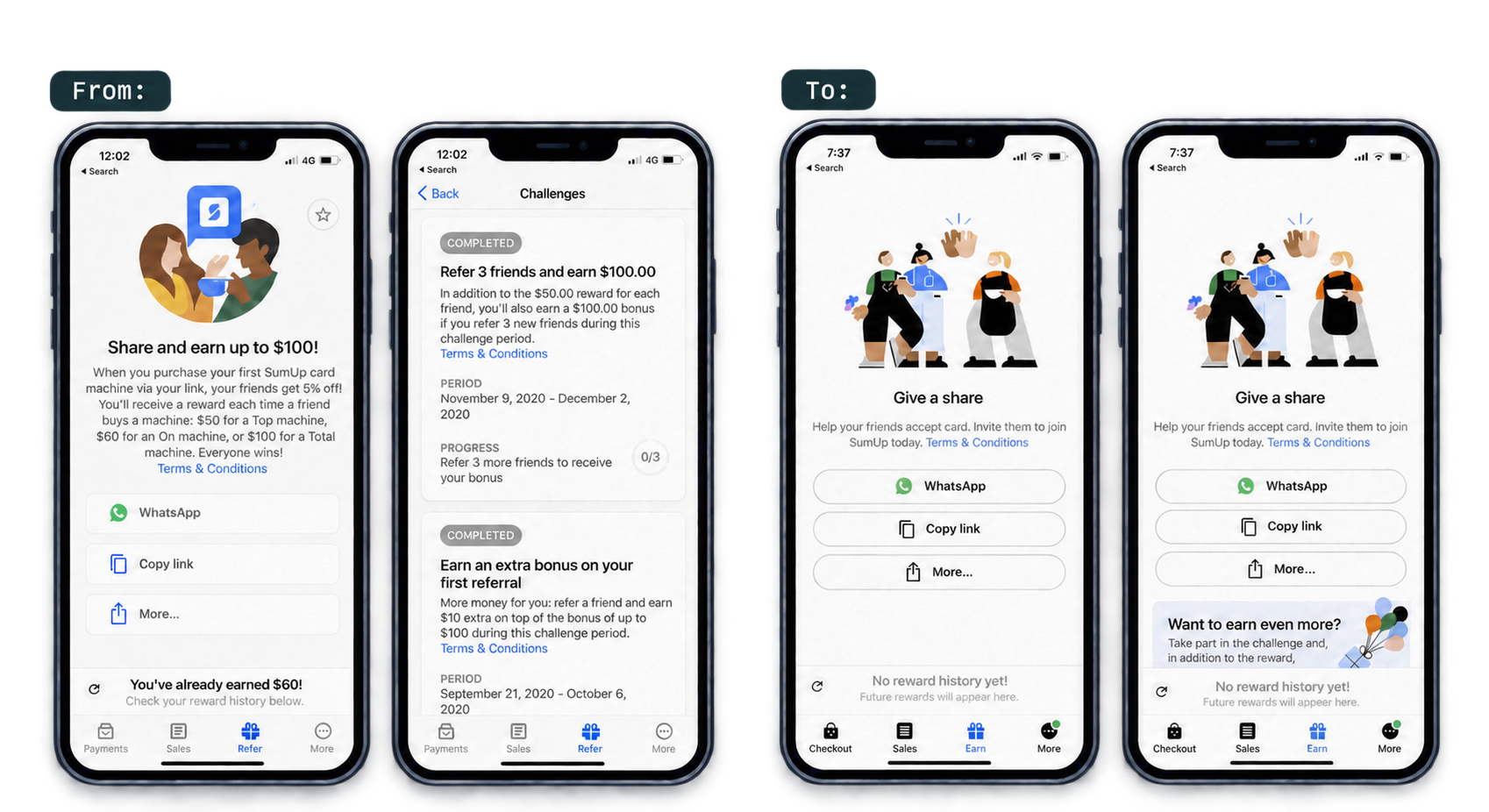
To
Latest
04
Programme evolution
From a single referral to more ways to earn.
The programme evolved to support offers for specific products, seasonal promotions and time-limited referral challenges. Merchants could earn an additional bonus by reaching a set number of successful referrals within a defined period.
This connected with the opportunities I had mapped: refining the interface to make relevant promotions easier to discover and helping merchants share offers for specific card readers.
As the offer became more flexible, the interface needed to make the product, reward, qualifying conditions and deadline clear. For referral challenges, it also needed to explain progress towards the extra bonus.
Product offers
Share a specific product.
Earn its referral reward.
Seasonal promotions
Discover a relevant offer.
Refer during the promotion.
Referral challenges
Reach a conversion target
within a set time.
Making referral codes visible and usable.
Another opportunity I mapped was access to referral codes. Codes had been visible only to selected, recognised sellers, limiting their discoverability for other users.
A subsequent update informed by this research made the code visible within the referral experience. The SumUp Pay example below shows a share-code action, a dedicated field for entering a referral or promotional code, and confirmation of the bonus and qualifying steps.
For the person referring
For the invited friend
Invite a friend

Better togetherGive £20.
Give £20.
Get £20.
Invite a friend to SumUp Pay. You’ll both earn £20 when they:
- Verify their account
- Make 3 card payments within 30 days
Refer up to 5 friends and earn up to £100. Programme terms apply.
Share code: NEWHIRE2026
Enter a code
An invitation for youYour code.
Your code.
Your reward.
Have a referral or promotional code? Add it below.
Referral or promotional codeNEWHIRE2026
Code added£20 referral

£20 referral
bonus
Make 3 card payments to earn your referral bonus.
Got it
05
Outcomes & value
A clearer audience.
A more focused direction.
The work produced a research-led roadmap for the next quarter and evidence to build product personas. We gained a clearer understanding of merchants’ motivations, preferences, pain points and expectations.
After the changes were implemented, link shares increased by 20%. The new touchpoint gave merchants another way to discover and share the programme.
We also began tracking programme awareness and satisfaction, with the dedicated programme survey recording a 93% average evaluation from 1,700+ answers. This gave the team a baseline for understanding the experience and monitoring future changes.
Alongside the increase in sharing, the wider value was a foundation for future decisions: clearer audience understanding, relevant moments in the merchant journey, and measures the team could track over time.
I also mapped opportunities to refine the interface around future promotions and referrals for specific card readers. This gave the team a direction for helping merchants discover relevant offers and share the right reader with a friend.


Confidentiality
Research response counts are rounded. Internal segmentation, research scripts and detailed roadmap information are omitted.
06
Takeaway
Understand the recommendation before designing the referral.
For me, the key insight was that programme data captured only part of the behaviour. Understanding how and when merchants already recommended SumUp gave us a more grounded direction for growth.
Understand motivation→Find the relevant moment→Make the benefit clear
← Back to selected work